Of the many lessons my parents tried to teach me growing up, perhaps the one that stuck the most had to do with personal debt. Unfortunately, through the wrong example, I learned what a slave to debt a person can become. I also learned that the only true, lasting fix to debt, is to be disciplined in your spending habits. I further learned in the midst of this, that interest never sleeps. It works 24/7/365 and you literally are a slave to it until it it gone.
I've been telling my family, friends, co-workers, subscribers, and pretty much anyone who would listen, that the primary reason I do not believe the economy has recovered in the past few years, in spite of all the hype to the contrary, is because of our deficit spending and our debt as a country. Some nod their heads and seem to agree. Others argue and regurgitate the talking points from the media about it not being that big a deal. Others seem to not really care and treat it like many other political lightning rods: they hide from it. They bury their heads in the sand.
Well, some are finally figuring it out, and that is why I wanted to share this article I read today. I found it on Foxnews.com and it credits the AP for the article. I wish I knew who specifically to give credit to, but let me just say "bravo for someone starting to get it".
http://www.foxnews.com/politics/2013/09/17/new-study-warns-us-long-term-debt-problems/
Tuesday, September 17, 2013


Monday, September 9, 2013
NFLX Adjustment
At Safe Option Strategies we teach trade adjustments. We believe that any trade you open should be one you could adjust in case the stock moves contrary to what your expectation is. But, it is a common misconception that any trade can be adjusted to profitability when it goes against you. While that is an ideal scenario, sometimes what an adjustment will do is simply lessen the loss on a trade.
A great example of this is a trade we opened on NFLX about three weeks ago. The trade moved as badly against us as possible, and did so in just one day. By the time we could react and make an adjustment (our secondary exit plan) we were already looking at our max loss in the trade. By adjusting, we have now created a situation where we will still take a loss, but rather than 100% of our max loss, we are looking at between 35 and 50 % of our max loss.
To see this trade and the adjustment we made to it click here.
A great example of this is a trade we opened on NFLX about three weeks ago. The trade moved as badly against us as possible, and did so in just one day. By the time we could react and make an adjustment (our secondary exit plan) we were already looking at our max loss in the trade. By adjusting, we have now created a situation where we will still take a loss, but rather than 100% of our max loss, we are looking at between 35 and 50 % of our max loss.
To see this trade and the adjustment we made to it click here.
Monday, July 22, 2013
No Worms in This Apple
Before I even get into stocks, and more specifically into
Apple, I want to tell you about my two favorite times of the year. See, I’m a big sports fan. I loved watching Phil Mickelson win the Open
yesterday because I love golf. I like watching baseball, and
basketball, and college football, and golf, and tennis, and soccer. I love to play golf, or throw a baseball with
my younger son or daughter. I love to
shoot baskets with my college age kids, or take them to an occasional MLS
soccer, or NBA game. My wife and I play
tennis whenever we can. It’s part of who
we are.
Because I’m such a sports nut, I have two favorite times of
the year, March, and October. March is
amazing because it’s the NCAA Men’s Basketball Tournament. In my opinion, it is the best sporting event
of the whole year. March is also the
beginning of baseball season, the push for the playoffs in both hockey and NBA
basketball, and The Master’s Golf Tournament is just around the corner. I love October because of the World Series,
College Football back in full swing, and the start of the NBA and the NHL. I drive my family and friends nuts with my Bracket
Challenge (that’s for the NCAA Basketball Tournament for you non-sports fans)
in March and with my World Series predictions and NBA pre-season analysis in October. I sing lines from Christmas songs (“It’s the
most wonderful time of the year.”) when December is three months away or three
months past. If you are a sports fan like I am, these two times of the year are just plain exciting.
As an avid trader in the stock markets, I get four months
each year that bring me the same kind of excitement: January, April, July, and
October…..Earnings Season! It is that
truly magical time we get each quarter when up is down, front it back, and East
is West, because nobody really knows what is going to happen to a company's stock price when
it reports its quarterly earnings. Take
Apple, Inc. for example.
On the drive into my office this morning I heard that several
of the top analysts are split on what to expect when Apple, Inc. reports its
quarterly earnings on Tuesday at the close of the markets. One says the company is going to strongly
disappoint. Another says that new iPhone
activations are going to top expectations and the company is going to beat
projections and do great. Yet another is staying as
neutral as possible (coward) and saying it all depends on whether or not any
new products or significant product announcements come out in the conference
call. And that is the excitement in my
opinion: nobody knows.
There have been a lot of naysayers to Apple since the
company stock price hit an all-time high of $705.07 (the intra-day price was a
bit higher, but this is the highest closing day price the stock experienced) in
mid-September of last year. At that
time, the analysts’ consensus on Apple was that the stock would go to $1000 per
share before the end of 2013. 95% of all
the analysts at the time were wrong on picking a continued bullish direction on
Apple. It reminded me of the New England
Patriots undefeated regular season a few years ago. All the sports talking heads had them as a
lock for the Super Bowl that year. Well,
it was an amazing run, and the team got to the Super Bowl, but got defeated by
an upstart young quarterback names Eli Manning (I think he has an older brother
who plays too). The point is no one
could predict what would really happen.
Apple’s woes since hitting its high stock price have been
blamed on different things: 1) Lack of new products or innovations in the
pipeline. 2) The rise of other smart
phones to better compete with the iPhone (mostly the Samson Galaxy). 3) A slowdown in Mac sales as more and more
people move toward tablets and netbook style computers. 4) Stronger competing
products to the iPad. And let’s not forget
my personal favorite, 5) the loss of a far too young Steve Jobs, who has long
been identified as Apple. Apple is Jobs
and Jobs is Apple. I have heard rumor
that some guy named Tim Cook has taken over, but I still don’t really know who
he is.
I’m not quite ready or willing to make a prediction on what
the price of Apple stock will do after its announcement tomorrow, but I am more
than willing to tell you why I still think this is a great company. It’s simple for me really: great
products. Apple products, in my opinion,
still hold up strong, and in most cases better, than any competing product out
there when put to a head to head test. Let
me offer some evidence to my humble opinion:
Last week Microsoft had an incredibly disappointing earnings report. A big part of that was $900 million in tablet
inventory. See, Microsoft came out with
this great new tablet called Surface, which was going to be the first thing to
really challenge the iPad. Well, there
seems to be more of them sitting on Microsoft’s shelves than moving off the
shelves in stores. I’ve seen the
Surface. It’s not a bad tablet. Its only problem is that it’s not an iPad,
and iPad is the best tablet, hands down, on the market. I own a couple of iPads, and one other brand
of tablet (I’ll keep the name of it to myself).
The other brand tablet I have won’t charge anymore (and it is by the way
the newest of the three tablets I own).
I got online just last night to see if someone knew a great fix for
it. I was shocked when I found out how
many people had the same problem with the device and even more shocked at all
the other problems people have had with this device. And this device is one of the better sellers
out there. This got me thinking a
little, so I searched several other devices that have “challenged” the iPad in
recent years. I found the same
thing. Lots more problems than Apple’s
tablet.
I’ll give you another example: I have friends and family who have every
variety of smart phone on the market.
I’ll take my iPhone over any of them, any time. I know far more people who switch from other
smart phones to iPhone than the other way around, despite what you might hear
otherwise. It is just a better product. I told my wife last night that the next
version of iPhone will probably have a wider screen to compete better with the
Galaxy and some other smart phones. She
looked at me and said, “Why? This one fits perfect in my hand and in my
pocket”. Great point sweetheart. It’s a great phone the way it is.
From here you can go to laptops and desktop computers. Do you know anyone who owns a Mac, and other
brand computers? You probably do. And they probably all say the very same thing
I say: my Mac is the best of them. It’s
just a better product.
As long as the quality of the products is what it is, I
believe the competition still has a way to go to catch up to the quality of
Apple products. Would I like to see some
new things come from Apple? Sure I
would. And I actually disagree just a
little with my wife about the screen size on the iPhone. But, until someone has something better, I’m
still putting my money on Apple.
Like I said earlier, I don’t know what will happen to the
price of the stock after tomorrow’s earning announcement. I am not an analyst, I’m just a guy who uses
the products and trades the stock. I do
know this though, Apple is still a great company, and at its current price, I
believe still a good stock to own.
Here is one last thing to consider: When I look at stocks I want in my portfolio,
I look for companies that enjoy some health financially. My silly, common sense approach tells me that
if I fill my portfolio with healthy companies, I increase my chances of having a
healthy portfolio. Apple, Inc. currently
has about 40 billion dollars in cash, and 0 dollars in debt. If my portfolio is a barrel, there are no
rotten apples in it right now.
Wednesday, July 10, 2013
Closing Another Profitable Trade
We are closing our bull put spread on Facebook this morning. The trade, in only two days has more than half the profit we could gain as our max ROI. We like taking money off the table when we can. Here is what the trade looked like a couple of days ago when we opened it:


We will close it today for about $0.21 per share. We took in a credit of $0.46 per share against a spread in the strikes of $3.00. Our max risk getting into the trade was $2.54 per share. This means our max ROI would have been 18% had the trade expired worthless. By closing today and capturing $0.25 credit we are getting about a 10% profit on a two day trade.
We publish all our trades for our subscribers before we open them, so that they can follow us in the trades if they choose. Check us out at www.safeoptionstrategies.com
Tuesday, July 9, 2013
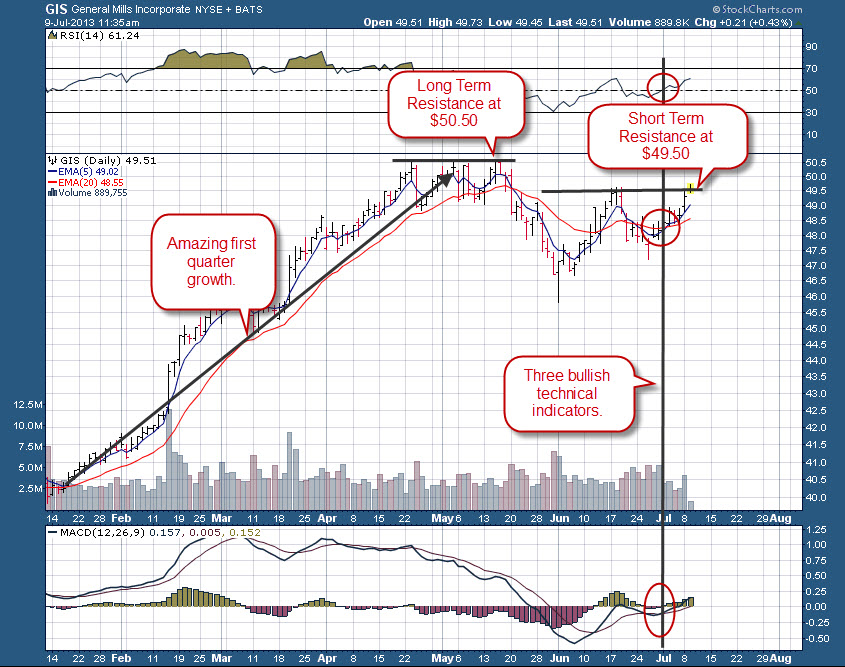
General Mills Feels Healthy Right Now
We think the timing is right to profit from a bull put spread on GIS, or get into shares through a bull put spread. Here's a trade we are opening today as a bonus trade for our subscribers:


If the trade expires worthless we profit about 17.5%. If we take stock ownership, we will simply collar the trade. Either way we believe we have a winner here.

If the trade expires worthless we profit about 17.5%. If we take stock ownership, we will simply collar the trade. Either way we believe we have a winner here.
Impressive Record
Once in a while we toot our own horn. This is one of those times. Check out our last couple months of trades:
Recent Trades
6/27/13 - BBRY Call Ratio Back Spread - 28% ROI in two days.
6/24/13 - MON Call Ratio Back Spread - 10% ROI in three days.
6/17/13 - ADBE Strangle - 17% ROI in three days.
6/10/13 - SNDK Calendar Strangle - 10% ROI in eight days.
6/03/13 - NFLX Bull Put - 18% ROI in four days.
5/28/13 - S Married Puts - Open trade.
5/21/13 - CAT Strangle - 25% ROI in six weeks.
5/14/13 - DE Call Ratio Back Spread - 17% in seven days.
To learn more about what we do and how we do it, go to www.safeoptionstrategies.com
Recent Trades
6/27/13 - BBRY Call Ratio Back Spread - 28% ROI in two days.
6/24/13 - MON Call Ratio Back Spread - 10% ROI in three days.
6/17/13 - ADBE Strangle - 17% ROI in three days.
6/10/13 - SNDK Calendar Strangle - 10% ROI in eight days.
6/03/13 - NFLX Bull Put - 18% ROI in four days.
5/28/13 - S Married Puts - Open trade.
5/21/13 - CAT Strangle - 25% ROI in six weeks.
5/14/13 - DE Call Ratio Back Spread - 17% in seven days.
To learn more about what we do and how we do it, go to www.safeoptionstrategies.com
Friday, June 28, 2013
BBRY does great by us!
On Wednesday, and obviously in anticipation of the Friday earnings report, we opened a call ratio back spread on BBRY. We were betting on a downward trend, but had great protection to the upside if a surprise home run was hit by the embattled cell phone maker. We closed the trade today for the full profit. 28% on a two day trade. Here is what the trade looked like:

Thursday, June 20, 2013
Banking on the Fed
Banking on the Fed by Jeffry Dunyon, Editor/CEO, Safe Option Strategies
Yesterday Ben Bernanke announced a timeline for the tapering of the Fed’s stimulus based on certain economic projections. The ongoing stimulus is the purchasing of assets which primarily involves bonds. Immediately following the announcement the major markets seemed to jump off a small cliff. Maybe not the kind of drop that could spur a panic of Black Monday proportions, but certainly enough of a panic to cause more than one day trader to pucker up and punch a new computer monitor. After seeing 15,318 early in the day, the DOW took a sharp turn around 2:50 Eastern Time and ended the day at 15,130, a drop of more than 188 points from its high, which was very close to the previous days close. Add to this the 200 point drop at the open of today’s market, and you have what some investors are already calling the beginning of a sizable, if not major correction. While it is yet to be seen if today finishes down, or if the week ends on a bearish note, we have already seen that the Fed’s plan to taper is seen as a reason to sell.
So, why the panic? Why choose to sell over good new? Isn't the Fed’s decision to taper based on economic forecasting of good, not bad news? Hasn't the Fed printed enough money and devalued our currency enough already?
I believe the first answer to these questions is simple: Most people do not fully understand (or even partially understand) what the Fed does.
Here are a couple of things I believe most people do not know, or do not want to know about the Federal Reserve: 1) When it was created, the Federal Reserve’s only three mandates were: Maximum Employment (something that most people, including myself still do not completely understand); 2) Stable Prices; and 3) Moderate Long-term Interest Rates. That was it. But, since its creation in 1913 its role has significantly expanded. Things like “conducting the nation’s monetary policy” have been added. Other expansions include “providing financial services (i.e. loaning money) to depository institutions, the U.S. government, and foreign official institutions (that last one it code for the UN)”, etc. The expansion has been significant and that was evidenced yesterday by the drop in the markets on the heels of the Chairman’s comments.
A greater or broadened understanding of what the Fed does may help someone understand how a Ben Bernanke announcement could move the markets, but it still doesn't answer why the specific announcement yesterday would cause a sell off. Well, here is some further Fed education for those who may not know:
The Fed makes money when it loans money at 6% interest and when its borrowers pay back the money. That’s a good thing, right? WRONG! When the number one borrower from the Fed is the US government (who, let’s be honest, doesn't have the best spending habits to begin with), and any interest the U.S. government is paying back to the Fed is tax money, how is it a good thing that the Fed makes money? It’s nothing more than a redistribution of our money from one government entity to another. Interest paid by the U.S. government, to the Fed, increases the deficit and therefore the national debt. That is not a good thing, and you do not need a degree in economics, nor do you need to be on a certain side of the political isle to understand it. Debt is not good. Deficit spending is not good. In 2010 the Fed made $82 billion dollars profit and a majority of that came from the U.S. government. In 2011 the amount was similar. They may say profit, but I call it debt.
The Fed spent far more money each of the past several years on purchasing assets for purposes of stimulating the economy. That’s one of its mandates, remember? “Conducting the Nation's monetary policy.” So, if the Fed is in the lending business, and it spent far more than it made, where did the extra money come from? Who did the Fed borrow from? This is the question many financial talking heads could answer, but won’t. Or, if they will answer this question, the viewers do not want to hear it. Or, ideology gets in the way of a willingness to listen and exercise some common sense. The answer to the question is that the Fed doesn't borrow money, it prints it. Every time the Fed spends more money than it brings in, it prints the extra money it needs. Every time the Fed prints more money, every single dollar in circulation, by way of the added dollars the Fed puts into circulation, lessens in value. Again, this does not take an advanced financial degree to understand. More printed currency added to the economy devalues all the currency in the economy. A devalued U.S. dollar is not a good thing.
Now bring this all back to the drop in the market today and yesterday, because there is a second answer to “why the sell off?”. Why is the Fed’s plan to taper the purchasing of assets for the purpose of stimulating the economy a bad thing? You might come to the same conclusion as me if you ask the question in a different way. ‘Why is the Fed’s tapering of 1) adding to our deficit spending and our debt, and 2) devaluing the dollar, perceived as a bad thing by the investment community at large? ‘ Why is the economy’s improvement (which is the forecast the Fed is basing its tapering decision on) a bad thing, or put more into trading terms, a reason to sell?
I believe the second answer lies in the shift of thinking found in many Americans and many investors, that the government should fix our problems. Now, this answer is going to rile a lot of conservatives (and please understand that the purpose of this article is not political), and is going to offend a lot of liberals. Well, that just too bad. It’s the truth. Even the capitalist who dominate the investment community have come to believe in large part that the government should provide solutions to our problems. What other mindset could explain why the Fed doing a good thing, is perceived by investors as a bad thing? It takes the same mentality that believes getting people off welfare by taking it from them and forcing them to get work is a bad thing, to believe the Fed weaning of stimulus money is bad.
Look, I know there are other things at play here, and I readily acknowledge that this is my opinion. But, let’s get real; get our heads out of the sand; get our common sense back, and recognize that the Fed’s suggestion of an improving economy could allow them to do a good thing sooner than otherwise planned…..is a good thing! Selling off in the face of good news......not a good thing.
Wednesday, June 19, 2013
ADBE Trade Results
On Monday AM we opened the following trade on ADBE:
 We put together a strangle in anticipation of the Tuesday earnings report. Just thought we would share the good news; we closed the trade today (two day trade) for a net gain of 17%. If you are a subscriber to the web site you saw everything in real time (click here).

On Monday AM we opened the following trade on ADBE:


Monday, May 20, 2013
Looking for some profit on CAT
We placed a new trade for CAT at the open of the market today. For SOS subscribers, it was on the web site last night so you could follow along in real time. For non-subscribers, we will post the trade later today or tomorrow so you can still learn from the strategy and the adjustments. http://www.safeoptionstrategies.com/subscribers/member_home.html
Wednesday, May 15, 2013
DE Call Back Ratio Spread
On Monday we opened a Bear Call spread with a disproportionate amount of long to short calls. We got a total credit of $0.76 per share. On the drop in today's price of DE (what we predicted would happen) we can close part the trade now with $0.50 of the total credit. We are however going to leave half of our long calls open. We think today is a temporary dip, and the the earnings and guidance announced this morning for DE will get the stock moving back up soon.
Here's what the trade looked like:
 Our Net ROI on this trade is just under 12% and it has been open for barely two days. If the long calls we are leaving in place gain any value at all before we close them, we make even more. But here this the best news: the remaining long calls are on total autopilot. We could lose the remaining value on them and it does not change the profit in our trade at all. It's "SAFE" to call this one a winner!
Here's what the trade looked like:

After a bit of a hiatus we are back and better than ever. Check out the new website at www.safeoptionstrategies.com and keep coming back for commentary and updates on our latest trades.
Monday, June 6, 2011
AAPL One Week Bull Put Spread
Our trade opened today at a credit of $0.47/share. We got a credit of $1.17 on the $335 short puts were debited $0.70 on the $330 long puts. We can get a max ROR of 10.3% at the end of the week with both options expiring worthless. The move up this morning is encouraging. We will update later in the day or the week if we see an opportunity to get out with 5-7% ROR in a day or two.
Tuesday, April 12, 2011
Bear Crossing Ahead
I came across this article in my reading today and found it very enlightening. In my opinion it is worth the time to read. http://finance.yahoo.com/banking-budgeting/article/112528/stock-market-history-marketwatch?mod=bb-budgeting&sec=topStories&pos=5&asset=&ccode=
One of the biggest challenges for most investors is profiting on bearish moves in the market. Our tendency as traders is be optimistic and look for bullish opportunities. It is a hard habit to get out of. Bearish markets give amazing opportunities for profits if you know how to position your portfolio to take advantage. You also need to know how to adjust. Don't go into this earnings season without that knowledge. It can wipe you out.
One of the biggest challenges for most investors is profiting on bearish moves in the market. Our tendency as traders is be optimistic and look for bullish opportunities. It is a hard habit to get out of. Bearish markets give amazing opportunities for profits if you know how to position your portfolio to take advantage. You also need to know how to adjust. Don't go into this earnings season without that knowledge. It can wipe you out.
Wednesday, March 23, 2011
Closing NKE ITM Bear Put
I'm going to set a limit order to close this trade now. I could make $0.65/share in the best case scenario. Right now I could easily get out of the trade with close to half that. While $0.30/share does not seem like a lot, it is almost a 7% ROI in only two days. Anytime I can get out of a trade in only two or three days with 6 or 7% I'm taking the money. My limit order is going to be a limit credit order for $4.70.
Sunday, March 20, 2011
NKE ITM Bear Put
I'm opening a trade tomorrow morning that is somewhat out of the box. I will buy to open an Apr11 In The Money Bear Put on NKE. Nike, Inc. reported its quarterly earnings last week and had a huge drop with very significant volume.


With $80 per share setting in as the likely new resistance level an ITM Bear Put will work similar to a credit spread. The trade will consist of an Apr11 $85 strike long put and an Apr11 $80 strike short put. The net cost of the trade is $4.35 with a $5.00 spread. This means that if the stock price stays below $80 per share, stock will be put to me at $80 and I will have the right to sell at $85 for a $5.00/share net gain. Subtracting the net debit of the trade ($4.35) I will see a profit of $0.65/share. On a $4.35 debit that is a 15% ROI. The sooner the stock is put to me the better. 

Wednesday, March 16, 2011
Closed AAPL
I bought my AAPL 330/325 bull put credit spread about five hours after opening the spread. Why? Because I had roughly 2/3 of my maximum profit in that time, so why take the risk holding onto the trade for three more days for only another 1/3 profit. I'll take 8% profit in 5 hours any day.
Tuesday, March 15, 2011
AAPL 3 day bull put credit spread
With the U.S. stock marketing selling off sharply at the open, following Japan's Nikkei Index dropping off 11%, I started watching the chart on AAPL. AAPL opened $11 lower than where it closed the previous day and I believe AAPL will stay about where it is now or rally between now and expiration Friday, which is in three days. So I sold the March 2011 330/325 puts for a $.60 credit. While I'm hoping to enjoy over a 13% return in three days, I realize this is a high-risk trade. Although there are a few adjustments I could make if this trade goes against me, I am not willing to take ownership of AAPL stock at $330 so I'll be monitoring this trade closely and if AAPL breaks below $335, I'll close this trade out.
Thursday, March 3, 2011
Welcome New Members From Sacramento MAP Group (and Guests)
On Saturday the 26th of February I had the privilege of sharing some our methodology and strategies with an investment group in Sacramento called the MAP Group. I had a wonderful time and received some very nice compliments from the group members. I wanted to thank them for the opportunity and for the wonderful hospitality. I also want to welcome those who have now joined the SOS community. We look forward to your comments and input in our trading community and also look forward to your continued trading success.
Jeffry Dunyon
President
Safe Option Strategies
Jeffry Dunyon
President
Safe Option Strategies
Subscribe to:
Posts (Atom)